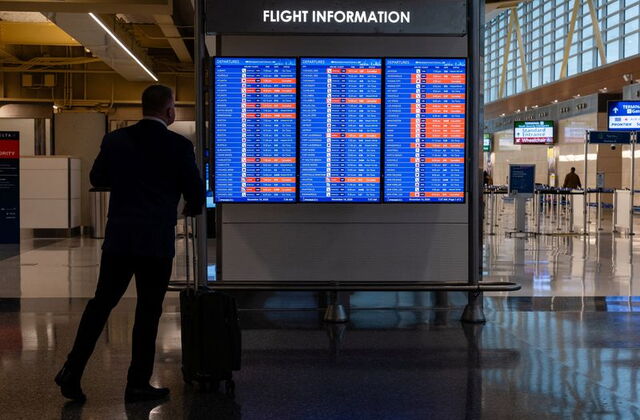
Air travel disruptions across the United States are expected to persist until late Sunday as the aviation system gradually recovers from a nationwide shutdown caused by communication network problems, the head of the Federal Aviation Administration, Bryan Bedford, has said.
The disruptions, which left tens of thousands of passengers stranded at airports, resulted in more than 14,000 flight cancellations and delays on Saturday.
According to FlightAware, an aviation tracking website, airlines cancelled over 6,400 flights and delayed more than 8,000 as of 9:35 p.m.
Eastern Time. Another 875 flights scheduled for Sunday had already been cancelled.
The crisis followed a nationwide ground stop imposed by the FAA on Friday, which halted nearly all departing flights for almost five hours.
The agency’s decision was prompted by instability in air traffic control communications and radar systems. Bedford apologised for the disruption, saying airline operations were expected to largely return to normal by late Sunday.
US Transportation Secretary Sean Duffy said the incident was traced to the installation of a new router by FAA contractor L3Harris at a remote facility.
Investigations are ongoing to establish whether the problem resulted from human error or a faulty device.
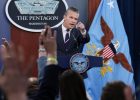
“We’re working to determine whether we had incompetence, meaning was it user error or installer error from L3Harris, or did they install a faulty router? We haven’t determined what the fault was,” Duffy said at a press conference.
The Professional Aviation Safety Specialists union, which represents FAA safety employees, said the disruption was linked to two routers updated on Friday.
An official told Reuters that the devices were believed to be located in Arkansas and Texas.
The union also said its technicians were not involved in the upgrades that triggered the shutdown, while L3Harris said it was supporting the FAA’s investigation.
Duffy explained that the router problem caused data overload at other communication centres, affecting air traffic control operations.
He said the system recorded an unusually high number of connection attempts, which disrupted communications with aircraft and affected radar operations.
“We had over 1,000 connection attempts every four to five seconds, and what that did was (it) gave us issues with our communication with airplanes, and it also caused some disruption with our radar,” Duffy added.
The disruption affected 17 of the FAA’s 22 en route centres, which oversee aircraft during the cruising stage of flights.
Bedford said the ground stop was ordered as a precaution against the possibility of a centre losing communication entirely.
He, however, clarified that no facility went completely offline.
The incident also forced major airlines to cancel a significant portion of their schedules on Saturday.
Delta Air Lines, United Airlines and American Airlines each cancelled about 25 per cent of their flights, while JetBlue cancelled nearly 45 per cent. Airlines have offered passengers waivers to rebook flights without additional charges.
The shutdown has renewed concerns about the condition of the US air traffic control system, which has been plagued by ageing infrastructure, equipment failures and a shortage of thousands of air traffic controllers.
Duffy has called for $50bn in funding to modernise the country’s air traffic control infrastructure, increasing his earlier request of $30bn.
Congress approved $12.5bn for upgrades last year, but Democratic lawmakers said only $1bn of the amount had been spent, despite contracts worth $4.3bn being awarded.
House Speaker Mike Johnson said he supported additional funding for air traffic control this year. Meanwhile, Democratic lawmakers Rick Larsen and Andre Carson pledged to hold the administration accountable for the incident and ensure measures were taken to prevent a recurrence.