A new report has raised concerns over corruption in Nigeria’s justice system, revealing that 67 per cent of prosecutors and 52 per cent of judges have been involved in bribery, with the figures more than doubling between 2019 and 2023.
The report, titled Judicial Corruption in Nigeria: Causes and Consequences, was released on Tuesday by the Platform to Protect Whistleblowers in Africa.
It drew on findings from a survey conducted by the National Bureau of Statistics and the United Nations Office on Drugs and Crime, which identified prosecutors as having the highest prevalence of bribery among the public officials examined.
The report also referenced a 2020 survey by the Independent Corrupt Practices and Other Related Offences Commission, which found that 11 out of 124 judges interviewed admitted receiving bribes totalling N3.7bn over two years.
It further cited findings by the Auditor-General of the Federation that N4.8bn was misappropriated or unaccounted for by federal courts between 2012 and 2015.
According to the report, corruption, political interference, external pressure and manipulation of judicial procedures have continued to undermine the administration of justice and weaken efforts to prosecute politically exposed persons and recover unexplained wealth.
Speaking during the virtual launch, governance and anti-corruption researcher, Matthew Page, urged journalists to investigate the assets and lifestyles of judicial officers to identify possible cases of unexplained wealth.
He said journalists should pay particular attention to senior judges whose properties, foreign assets and lifestyles appeared inconsistent with their legitimate earnings.
“We can wait for whistleblowers to sort of give us those smoking guns. But what is, I think, an easier and, in a sense, quicker method to finding out where there are problems is looking at this issue of unexplained wealth,” Page said.
He urged journalists to examine the property ownership, financial records and career histories of public officials to determine whether their assets corresponded with their legitimate income.
Page added that senior judicial officers should be subjected to public scrutiny because of the trust and responsibilities attached to their positions.
The report also identified prolonged court proceedings, procedural irregularities and preferential treatment in high-profile cases as factors weakening accountability in the country.
It cited the cases involving former governors Orji Uzor Kalu, Chimaroke Nnamani and Willie Obiano, as well as former pension reform boss, Abdulrasheed Maina, as examples of how judicial dysfunction and suspected corrupt interference could undermine anti-corruption efforts.
On Kalu’s case, the report recalled that the Supreme Court overturned his conviction in 2020 on a technical ground after a 12-year trial, despite the 2015 law permitting the trial judge to conclude the proceedings.
It noted that six years after the conviction was nullified, the former governor had yet to be retried.
Page also blamed the poor enforcement of existing laws for delays in the justice system, particularly in cases involving survivors of sexual and gender-based violence.
He argued that provisions of the Administration of Criminal Justice Act 2015, which was designed to accelerate criminal trials and discourage unnecessary delays, were not being adequately implemented.
“Before we start about new solutions, let’s fully implement the solutions that we already have and demand that Act be obeyed and held to more than it currently is,” he said.
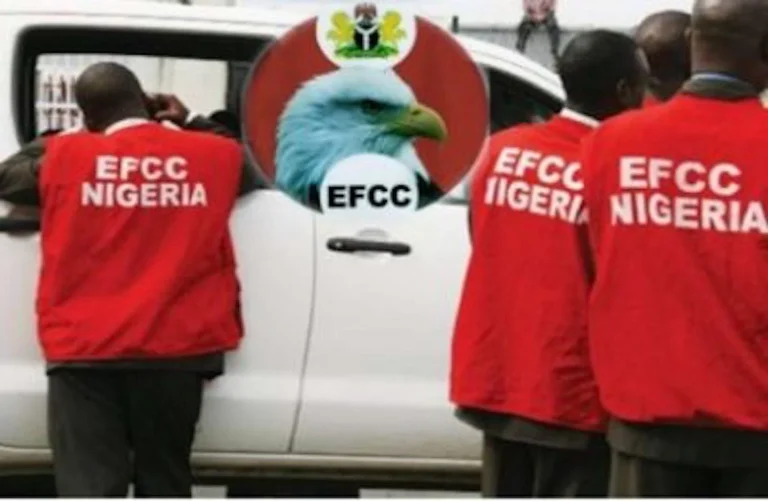
On the role of anti-corruption agencies, Page acknowledged that institutions such as the Economic and Financial Crimes Commission could sometimes be ineffective or compromised.
He referenced the case involving former Rivers State Governor, Peter Odili, arguing that the EFCC’s failure to challenge a perpetual injunction within the stipulated period allowed the order to remain in force.
He described the agency’s inaction as an “embrace of inertia”, warning that such failures could protect powerful individuals from accountability.
The researcher also supported proposals for digital or random allocation of court cases, saying the approach could reduce opportunities for litigants to influence the selection of judges.
However, he cautioned that manipulation of filing dates and the heavy workload of Nigerian courts could undermine the effectiveness of the system.
Page further called for legislation expressly prohibiting government officials from providing judges with mansions, sports utility vehicles and other benefits under the guise of judicial welfare.
Meanwhile, PPLAAF Executive Director, Jimmy Kande, said corruption and undue external influence continued to threaten the independence of Nigeria’s judiciary and the country’s democratic institutions.
“The Nigerian judiciary has been undermined from all sides through corruption, bribery, and undue external pressure. This has long-lasting impacts on democracy, the rule of law, and the daily lives of ordinary Nigerians,” Kande said.
He warned that suspected judicial corruption could prevent the prosecution of powerful public officials and allow assets allegedly acquired through unexplained wealth to remain beyond the reach of authorities.
Also speaking, Programme Manager of the African Centre for Media and Information Literacy, Godwin Onyeacholem, described judicial corruption as a major obstacle to human rights protection and democratic development.
He said corrupt practices within the judiciary had contributed significantly to Nigeria’s human rights challenges and democratic setbacks.
PPLAAF called for far-reaching reforms, including financial independence for the judiciary, stronger accountability mechanisms and greater transparency in judicial appointments, budgets, expenditure and procurement.
The organisation also recommended the publication and independent verification of asset declarations by judges and other judicial personnel, sanctions for procedural abuses and independent vetting of serving judges and prosecutors under international oversight.
PPLAAF, established in 2017, is a non-governmental organisation that protects whistleblowers, promotes their rights and pursues strategic litigation in matters affecting the public interest.