

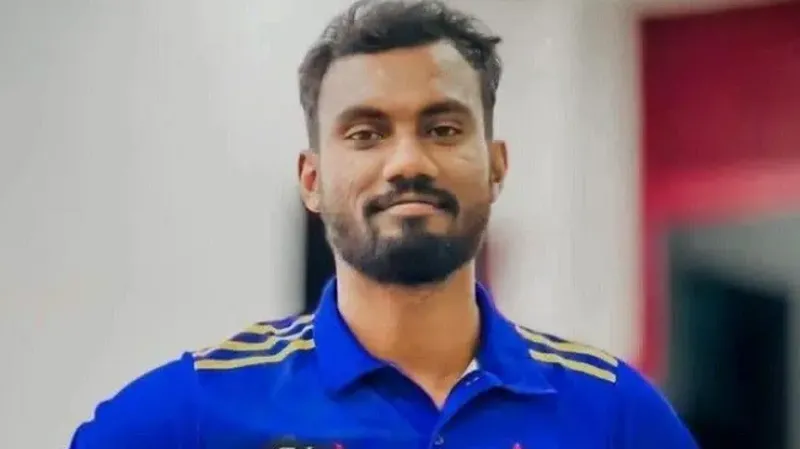
A 24-year-old Sri Lankan migrant worker, Anojan Sivarasa, is facing execution in Saudi Arabia after an appellate court sentenced him to death for blasphemy over a comment he made on Facebook.
Sivarasa was initially sentenced to five years in prison and fined three million Saudi riyals, about $800,000, by the Al-Ahsa Criminal Court after he was prosecuted under Saudi Arabia’s cybercrime legislation.
However, the case took a dramatic turn on September 17 when Saudi prosecutors appealed for him to be tried under Sharia law.
The appellate court granted the request and increased his punishment to the death penalty.
Sivarasa’s family has appealed for mercy, while the Sri Lankan government has launched diplomatic efforts to secure his release.
His mother, Rasamanickam Yogalakshmi, made an emotional plea for his life, saying, “I plead for mercy for the wrongs committed by my son. Please forgive him and send him back to us.”
The case began after a social media dispute linked to an incident during a Hindu pilgrimage in Sri Lanka.
A video of a Muslim man kicking a dog after Hindu pilgrims were involved in an incident circulated online in June, triggering arguments along religious lines.
During the exchanges, another social media user allegedly made derogatory comments about a Hindu deity, prompting Sivarasa to respond in Tamil with an insult directed at the Prophet Muhammad.
He later deleted the comment and published an apology video.
The comment was subsequently reported to his employer and Saudi authorities, leading to his arrest in July.
His electronic devices were seized, while his social media accounts were deleted by Saudi officials.
Sivarasa’s brother, Hamsidan Sivarasa, said people in Saudi Arabia were initially unaware of the incident.
“People in Saudi Arabia knew nothing about this matter. It was individuals in Sri Lanka who sent emails to the company where my brother worked. I do not even wish to mention who those people are,” he told BBC Sinhala.
According to Hamsidan, the company subsequently notified Saudi authorities, who opened a case against his brother.
The Sri Lankan Ministry of Foreign Affairs said it was taking all available measures to assist Sivarasa.
His family also met President Anura Kumara Dissanayake on September 21, with the president assuring them that the government would make every effort to obtain a pardon.
Religious leaders from Buddhist and Hindu communities have also joined calls for intervention, while a four-member Sri Lankan legal team is travelling to Saudi Arabia to meet lawyers handling Sivarasa’s case.
One of the lawyers, Upul Kumarapperuma, said, “There are two law firms in Saudi Arabia handling Anojan’s case. We are going there to meet the lawyers from these two firms, discuss the case and plan what can be done next.”
Meanwhile, Sivarasa’s family says they have been unable to communicate with him. His brother said on September 28, “My brother hasn’t called for two days.”
He added that the family had informed the Sri Lankan embassy and was still awaiting an update.
Saudi authorities have not announced when the execution could take place.
The BBC reported that Saudi Arabia has previously carried out executions without advance notice to families or foreign embassies.
Human rights organisations have raised concerns over severe punishments for online speech in Saudi Arabia.
Executions for blasphemy are considered relatively uncommon compared with death sentences for offences such as drug crimes and murder.


