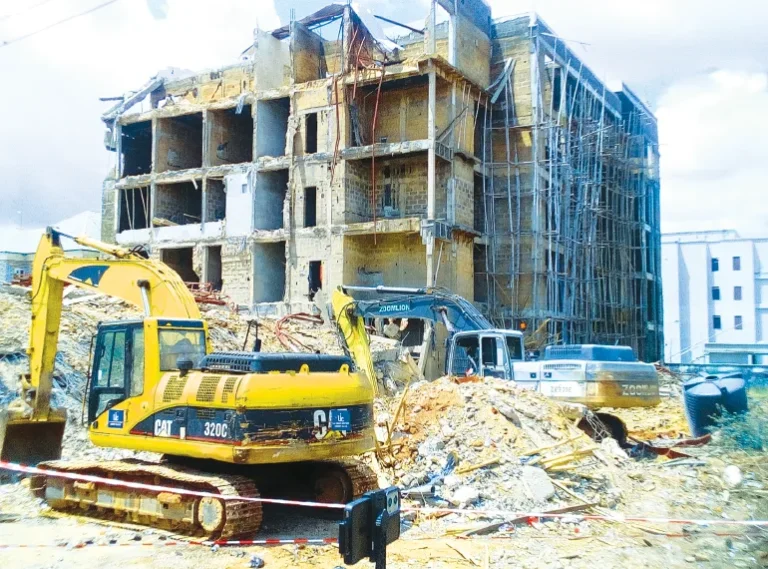
Experts from Nigeria’s built-environment professional bodies have blamed negligence and weak regulatory enforcement for the collapse of a four-storey building in Enugu, which killed one person and left another critically injured.
The Punch reported that the professionals, who visited the site on Monday to assess the remains of the collapsed structure, said the incident exposed serious shortcomings in construction practices, supervision and regulatory oversight.
Chairman of the Nigerian Institute of Town Planners, Enugu State chapter, Dr Christopher Anierobi, said the condition of the building indicated poor construction practices and inadequate supervision.
“This collapse is a result of gross negligence. You can see that the material mixture is completely inadequate. There was gross negligence on the part of the site engineers and a total failure of professional supervision,” Anierobi said.
Similarly, the Second National Vice President of the Nigerian Institute of Building, Dr Eucharia Enebe, said proper construction management, quality control and safety measures were crucial to preventing structural failures.
Enebe noted that the integrity of a building could be compromised before concrete was even poured, stressing that basic quality management, health and safety planning, and construction management procedures were lacking at the site.
The experts also raised concerns about Enugu’s planning framework, noting that urban development in the state was still guided by an unapproved 1979 document prepared during the administration of former governor, Chief Jim Nwobodo.
Anierobi and the NIOB Vice Chairman in Enugu State, Ani Chukwunoso, urged Governor Peter Mbah to domesticate the 1992 Nigerian Urban and Regional Planning Law and the 2006 National Building Code.
They said the move would strengthen regulatory enforcement and ensure that site supervision was handled by qualified professionals, including architects, structural engineers and registered builders.
The experts also expressed concern over another detached structure located beside the collapsed building, warning that the impact of the collapse could have affected its structural integrity.
Enebe said, “Because the first structure fell, it inevitably impacted the second. Full non-destructive integrity tests must be conducted before anyone can deem the remaining structure safe to occupy.”
The visit came a day after the Enugu Capital Territory Development Authority said its officials had inspected the structure and discovered deviations from approved engineering drawings, densification violations and structural modifications that were not monitored.
The ECTDA said the developer had obtained structural approvals but added that the preliminary findings prompted it to seal the immediate perimeter and commence an administrative investigation.
The agency also said any developer or supervising official found to have breached relevant regulations would face prosecution under state laws.
The professionals called for stronger enforcement of building regulations and modern planning laws, saying improved oversight was necessary to prevent further building failures in the state.