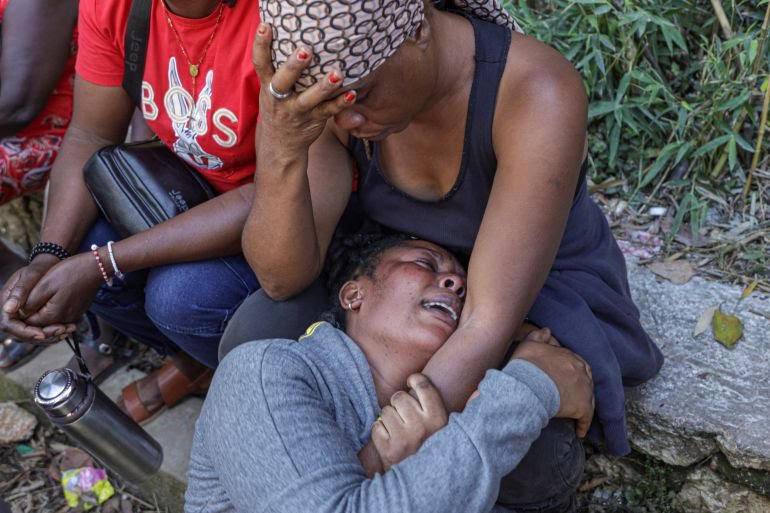
A gang in Haiti has released 13 hostages, including six children and seven women, days after abducting more than 50 people during a deadly attack on a community near the capital, Port-au-Prince.
UNICEF confirmed the release late Friday, saying those freed included three children below the age of two, a seven-year-old and two teenage girls.
The United Nations agency said it worked alongside community leaders to facilitate the release of the women and children.
It was not immediately known whether they required medical attention or if other hostages remained in captivity.
“This release offers a rare moment of hope amid the violence threatening children in Haiti,” said Yannig Dussart, UNICEF’s deputy representative in Haiti.
“The Kenscoff abduction was not an isolated incident but another stark reminder of the scale and frequency of attacks on children across the country.”
The mass kidnapping followed a deadly gang assault on Kenscoff, a farming community in the hills above Port-au-Prince. At least 47 people were killed during the attack, which took place late Sunday.
Mass kidnappings are less common in Haiti than individual abductions, although gangs frequently hold people for ransom. In some cases, captives are released without payment, while others have been killed even after ransoms were paid.
A gang leader identified as Izo 2 had reportedly threatened to kill all the hostages if police killed members of his group during efforts to retake Kenscoff.
Izo 2 operates in the area in coordination with other powerful gang leaders, including Izo, who is regarded as one of Haiti’s most influential gang figures.
The violence has also triggered renewed international concern over Haiti’s worsening security crisis.
At an emergency United Nations Security Council meeting on Friday, diplomats called for the rapid deployment of a new UN-backed force tasked with combating gangs and urged stronger action against armed groups.
UN special envoy to Haiti Luis Ruiz Massieu said the attack had sparked “a new wave of public indignation across all sectors of Haiti’s society, as well as international partners.”
Haitian authorities have brought together the national police, armed forces and the gang suppression force to assess the situation and coordinate their response.
The gang-fighting force is expected to increase its presence in Port-au-Prince, while Haitian security forces will strengthen their deployment in Kenscoff.
US Deputy Ambassador Jennifer Locetta said Washington remained committed to helping Haiti tackle the violence.
The United States “is resolved and as committed as ever to supporting Haitian-led security efforts to end gang terror.”
Locetta urged UN member states to provide the equipment and resources required for the international force to deploy quickly.
She also called for greater investment in employment, infrastructure and other opportunities to discourage young people from joining gangs.
She warned that gang coalitions had openly expressed an intention to prevent Haitians from choosing their representatives in future elections, saying “terrorists” must not be allowed to take democracy hostage.
“They cannot terrorize from the ends of rifles and from the comforts of toll stations – as they rob Haiti of their future,” she said, “We must protect civilians against these unconscionable acts.”
The Kenscoff attack forced more than 2,600 residents to flee their homes, according to Indrika Ratwatte, the acting UN assistant secretary-general for humanitarian affairs.
Many of those displaced had already been forced from their homes once or twice before, he said, adding that residents were traumatised and searching for missing relatives.
Nearly 1.5 million people, equivalent to about 12 per cent of Haiti’s population, are currently internally displaced, with children accounting for roughly half of them.
Ratwatte also raised concerns over the continued deportation of Haitians from the Dominican Republic and the United States.
He said almost 200,000 people had been forcibly returned to Haiti during the first eight months of 2026, representing a 10 per cent increase from the same period last year.
The humanitarian crisis has been compounded by widespread violence against women and children.
UN humanitarian partners documented more than 5,500 cases of gender-based violence during the first six months of the year, averaging about 30 incidents each day.