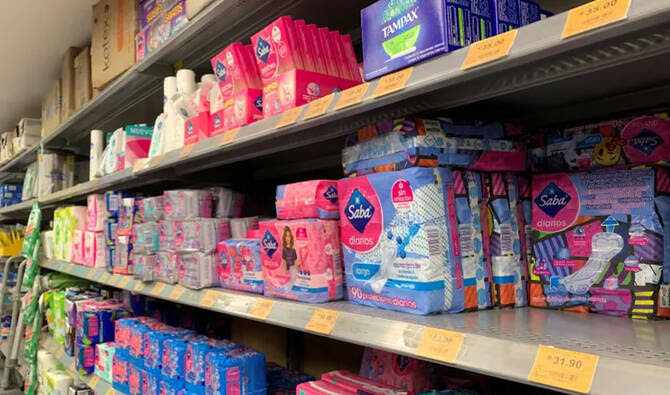
Pakistan is moving to scrap sales tax on sanitary products in a major fiscal reform that reproductive justice advocates say could help reduce long-standing stigma around menstrual and sexual health in the country.
The government announced plans in its latest budget to remove the 18% sales tax on sanitary pads and contraceptives. The proposal follows sustained advocacy for better access to menstrual hygiene products in a country where commercial usage remains very low.
Finance Minister Muhammad Aurangzeb defended the move, saying such products are vital for women’s wellbeing and inclusion in everyday life. Such items are “indispensable for women’s health, dignity and full participation in social activities,” he said.
He also confirmed that taxes on contraceptives would be removed, linking the decision to Pakistan’s rapid population growth.
“Pakistan is the fifth-largest country in the world in terms of population,” he added. “Family planning is a top priority of the government.”
The policy shift comes after legal action by lawyers Ahsan Jehangir Khan, 29, and Mahnoor Omer, 25, who challenged what they described as unfair taxation on menstrual products.
Their petition argued that sanitary items should be treated as essential goods rather than luxury items.
Data cited from the United Nations Children’s Fund UNICEF indicates that only about 12% of women and girls in Pakistan use commercial sanitary products, with most relying on cloth or other informal alternatives.
Activists say affordability is a key barrier, worsened by the 18% sales tax on local products and an additional 25% customs duty on imports, as outlined in the legal filing submitted by the petitioners.
Combined with other levies, the overall tax burden on menstrual products can reach around 40%, making access difficult for poorer households.
The petition argues that this structure violates constitutional protections, particularly Article 25, which prohibits discrimination on the basis of sex.
Khan described the taxation system as fundamentally flawed, saying, “If there was never a constitutional petition, the government would not have woken up to the fact that even the sales tax is wrong,” he said.
While welcoming the proposed tax removal, the petitioners insist that further reforms are needed, including the elimination of additional duties on raw materials used in manufacturing sanitary products.
Internationally, similar tax cuts on menstrual hygiene products have already been adopted in countries such as India, Nepal, Scotland, and several US states.
UN Women UN Women described the policy shift as a meaningful step forward, noting that improved affordability could help more women and girls remain in school and employment.
However, reproductive justice advocate Bushra Mahnoor, co-founder of the group Mahwari Justice, warned that structural issues remain.
She emphasized that while the reform carries symbolic weight, it may not fully address the needs of the most vulnerable populations.
“More than the impact this tax removal is going to have in prices, is the impact it has in de-stigmatizing menstruation, and we should not take that lightly,” she said.
She also pointed out that widespread poverty continues to limit access to menstrual products, with nearly 45% of Pakistan’s population living below the lower-middle-income poverty threshold of $4.20 per day.
Even where available, the cost of a pack of sanitary pads can consume more than a third of a daily income, making regular monthly use unaffordable for many.
The issue has also moved through Pakistan’s judicial system. Following a hearing in Rawalpindi, the court directed the government to respond to the arguments presented by Khan and Omer so the case could proceed toward final arguments.
In its official response, the government rejected claims that the tax regime was discriminatory or excessive, arguing instead that it was designed to support state revenue used to fund public services, including those benefiting women.
The case is now approaching final hearings, after which a ruling could determine whether Pakistan moves toward fully removing taxes on menstrual products, including import duties and levies on raw materials used in production.
For the petitioners, the development is significant but incomplete. “Our fight is very much ongoing, but we are elated that at least the government has realized that these are not luxury products,” Khan said.