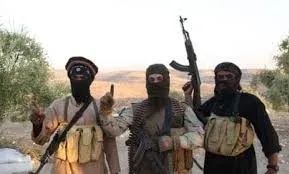
The Defence Headquarters has said that intelligence reports confirmed the presence of terrorist elements in locations targeted during the recent joint military strikes carried out by the United States and Nigerian forces in northwestern Nigeria.
The Director of Defence Media Operations, Major General Michael Onoja, disclosed this on Wednesday while responding to questions from journalists in Abuja, noting that a comprehensive battle damage assessment of the operation was still underway.
According to Onoja, the outcome of the assessment would be made public once the process is concluded.
“On the United States strikes conducted in conjunction with Nigerian forces, there is a process of battle damage assessment which is still ongoing. Once that is completed, we will communicate all our observations to the public in due course,” he said.
The clarification followed public debates over the effectiveness of the strikes, which were announced by US President Donald Trump on Christmas Day.
The Federal Government later confirmed that the operation was part of sustained counterterrorism cooperation between both countries.
Addressing concerns about whether terrorists were actually present at the bombed locations, the defence spokesman said the strikes were intelligence-driven.
“Those strikes were based on intelligence reports which confirmed the presence of terrorists in the areas before the operation was carried out. The fact that this was not publicised earlier was for operational security reasons,” Onoja explained.
He added that the proximity of the Sahel region to parts of northwestern Nigeria, including Sokoto, made the area vulnerable to terrorist movements.
The military, he said, was also monitoring the movement of terrorist elements outside the targeted locations to prevent them from infiltrating nearby communities.
“We are communicating with field commanders in identified threat areas to ensure that these elements do not assimilate into communities and cause further havoc. Some of our actions remain confidential, but in time, we will brief the public on our activities,” he stated.
Onoja stressed the importance of civilian cooperation in addressing insecurity, urging members of the public to provide timely and credible information to security agencies.
“Security challenges can only be addressed through the cooperation of every member of society. This is what we refer to as the whole-of-society approach,” he said.
He also appealed to individuals who might have picked up ammunition or fragments from the operation to return them to security agencies for safe disposal.
“We do not expect anyone to take away such materials. They should be returned to the military or relevant security divisions so that they can be safely recovered and disarmed,” Onoja warned.
Responding to criticisms surrounding the joint strikes, the military spokesperson said the armed forces would remain focused on their constitutional responsibilities.
“It is not the duty of the armed forces to respond to every public opinion. Our focus remains on kinetic and non-kinetic operations, while relevant agencies address other concerns,” he noted.
On recent suicide bombing incidents, Onoja described the arrest of a suspected bomber earlier in the week as a major breakthrough that disrupted planned attacks and logistics.
He assured Nigerians that the armed forces would sustain counterterrorism operations into the new year, using intelligence networks and coordinated security measures to prevent future attacks.