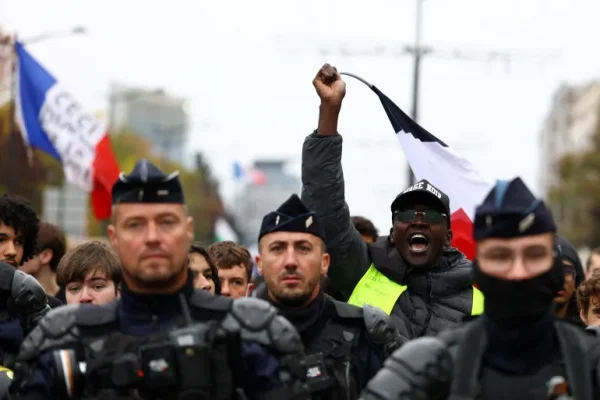
France is set to revive a limited form of military service as concerns grow over a possible confrontation with Russia.
More than two decades after ending conscription, the government plans to introduce a voluntary 10-month paid programme for young men and women.
Announcing the initiative at an infantry base near Grenoble, President Emmanuel Macron said, “The only way to avoid danger is to prepare for it. We need to mobilise, mobilising the nation to defend itself, to be ready and remain respected.”
The phased rollout will begin next summer and will primarily target 18- and 19-year-olds.
Participants will receive a minimum monthly stipend of €800 (£700).
Macron stressed that the world had become increasingly unpredictable, saying, “In this uncertain world where might triumphs over right, war is in the present tense.”
He added that the armed forces would benefit from committed young citizens, “It is an act of trust in our youth.”
Only 3,000 volunteers will be accepted for the first year, but officials expect that number to rise to 50,000 by 2035. France’s armed forces currently consist of about 200,000 active soldiers and 47,000 reservists.
The new scheme aims to create a three-tier system of professional troops, reservists, and volunteer recruits.
The move aligns France with several European countries that have reintroduced varying versions of national service amid rising anxiety over Russian aggression.
Belgium and the Netherlands now run voluntary programmes, Germany is working on a similar plan, and countries such as Lithuania, Latvia, Sweden, Finland and Greece maintain either compulsory or recently revived systems.
Military leaders in France largely support the proposal, seeing it as a way to build a pool of trained personnel who can assist professional forces, especially in non-combat roles.
They also hope the initiative will inspire some volunteers to pursue long-term military careers.
Thomas Gassilloud, head of the National Assembly’s defence committee, said, “The new military service moves us in the direction of hybridisation of the armed forces. We went too far in the direction of the all-professional.”
Debate around the threat posed by Russia has intensified, particularly after newly appointed chief-of-staff Gen Fabien Mandon warned that military planning assumes a potential clash with Moscow within the next few years.
He further told a gathering of local leaders that France needed to restore a “spirit of sacrifice,” urging them to mentally prepare the public for the possibility of “losing children” in war.
The comments drew swift criticism, prompting Macron to reassure the country that young volunteers would not be deployed to Ukraine.
Despite such controversies, public support for voluntary service is strong. An Elabe poll found that 73% of respondents favour the new measure.
Among 25- to 34-year-olds,the least enthusiastic group, 60% are still in support. A brief BBC survey on the streets of Paris reflected similar views.
Louis, a 22-year-old student, said, “It’s a good thing. It can help make the army bigger, but it’s also a way to love your nation more.” Another student, Eilan, noted, “In military service you meet people from everywhere. You learn new ways of seeing things… You learn to talk and trust and co-exist with other people.”
Brigitte, who works as a set designer, said, “From what I read in the newspapers, our army is not that powerful – so if we have to prepare for the future, maybe it’s a good idea.”
But Lalie, a 21-year-old shop worker, offered a different opinion: “I think there are more important issues. It’s a pity the president is not really interested in young people – their mental health, their financial situation, and instead is focusing on this military service.”
France originally scrapped conscription in the late 1990s under President Jacques Chirac, reflecting the post-Cold War optimism that followed the collapse of the Soviet Union.
For centuries, military service had been a fundamental part of French identity, dating back to the French Revolution and solidified by the 1798 draft law proclaiming that “Every Frenchman is a soldier and is bound to the defence of the homeland.” After France’s defeat in 1871, Republican leader Léon Gambetta declared, “When in France a citizen is born, he is born a soldier.”
The last major conflict to involve French conscripts was the Algerian war, during which more than 12,000 draftees were killed.
By the end of the 20th century, military service had been reduced to a 10-month term, with civilian alternatives available.
Since the final conscripts completed service in 2001, several attempts have been made to retain aspects of national civic training, including the Day of Defence and Citizenship still attended by lycée students.
Macron’s earlier attempt at a civic-focused Universal National Service, designed to promote unity after the terror attacks of the 2010s, was widely criticised and ultimately abandoned.
The new voluntary military programme, however, appears to be gaining traction, even as concerns remain about funding in the face of mounting national debt and budgetary gridlock.