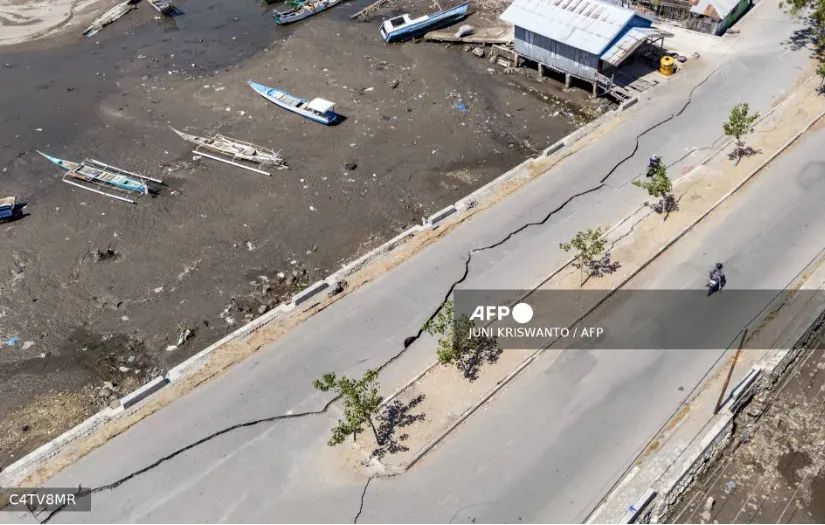
A powerful magnitude 6.3 earthquake struck northern Afghanistan in the early hours of Monday, sending frightened residents rushing into the streets and raising concerns of possible damage in remote communities.
According to the United States Geological Survey, the tremor occurred at a depth of about 28 kilometres, with its epicentre located close to Mazar-i-Sharif, one of Afghanistan’s largest cities in the north.
Although there were no immediate reports of casualties or large-scale destruction, emergency responders say communication gaps and difficult terrain could delay accurate assessments.
“We are still gathering information from surrounding districts. Some of these areas are hard to reach, so it may take several hours to know the situation fully,” an emergency response official in Balkh Province said.
Residents of Mazar-i-Sharif were jolted awake and forced outdoors in fear their homes might collapse.
An Afghan resident who spoke with local journalists said, “The ground shook so violently that everyone ran outside. We stayed in the open for a long while because we did not know if there would be another quake.”
Shaking from the tremor was also felt in Kabul, more than 400 kilometres away.
This incident adds to a series of destructive natural disasters that Afghanistan has endured in recent years.
Since the Taliban took control in 2021, the country has been hit by several major earthquakes, including a 6.0-magnitude tremor in August in the eastern region, which wiped out entire villages and killed more than 2,200 people.
Humanitarian organisations have repeatedly warned that Afghanistan is already struggling under severe economic strain, reduced foreign aid, drought conditions, and the return of large numbers of Afghans expelled from neighbouring countries.
“People are already dealing with hunger and displacement. Another quake brings fear that the suffering could worsen,” a humanitarian aid worker in Kabul said.
Afghanistan lies near the boundary of the Eurasian and Indian tectonic plates, making earthquakes common, particularly in the mountainous regions of the Hindu Kush. Many homes in rural areas are built with fragile materials, increasing the risk of collapse during tremors.
Authorities and aid agencies say they are monitoring the situation and preparing to deploy assistance if needed.